
Most people come to India for the monuments, the food and the festivals. Fewer realize how much room it has for adventure. Between the Himalayas in the north, the Thar Desert in the west and the islands far out in the Bay of Bengal, you can raft a holy river, fly over a mountain valley or dive a coral reef, often within a day’s journey of a big city.
If you volunteer in Delhi or Jaipur, your evenings and weekends are free, and a long weekend or a week after your placement is enough for most of the ideas below. They are all independent travel: you book them yourself with local operators, and your coordinator is happy to help you plan the journey.
1. White-water rafting near Rishikesh
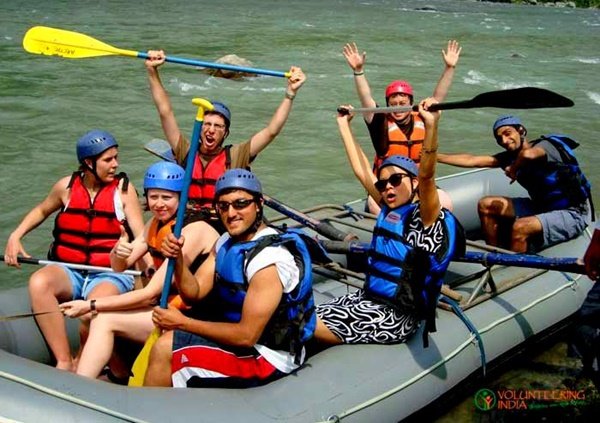
Rishikesh sits where the Ganges leaves the Himalayan foothills, and the stretch of river above town is India’s best-known place to raft. Half-day trips take you through a run of lively rapids with calm pools in between, where you can jump in and float. No experience is needed: operators give you a safety briefing, a helmet and a life jacket, and a guide steers the raft.
Rishikesh has plenty of other thrills, from a bungee jump over a nearby gorge to riverside camps and walks to forest waterfalls. Rafting stops for the monsoon, usually from July to mid-September. Rishikesh is about six hours from Delhi by bus, or take a train to Haridwar and finish the trip by road.
2. Paragliding at Bir Billing
Bir Billing, in the Kangra valley of Himachal Pradesh, is one of the world’s best-known paragliding sites and has hosted international competitions. You take off from the grassy slopes at Billing, high on the ridge, and glide down over terraced fields to land near the Tibetan monasteries and cafés of Bir.
First-timers fly tandem with a licensed pilot, usually for 15 to 30 minutes, depending on the wind. The best months are roughly March to June and September to November; flying is banned during the monsoon. Bir is an overnight bus ride from Delhi, so it suits a long weekend.
3. Trekking in the Himalayas
You don’t need to be a mountaineer to walk in the Himalayas. From McLeod Ganj, the Tibetan hill town above Dharamshala, a steep climb of a few hours takes you to Triund, a grassy ridge facing the snowy Dhauladhar range. In Uttarakhand, the Valley of Flowers, a UNESCO World Heritage Site, turns into a carpet of wildflowers during the monsoon months.
Spring and autumn bring the clearest skies. For anything longer than a day hike, go with a licensed local guide or trekking company, carry warm layers even in summer and give yourself time to get used to the altitude.
4. A night in the Thar Desert
Jaisalmer, the golden sandstone city in far western Rajasthan, is the gateway to the Thar Desert. Desert camps outside town take you into the dunes by jeep or camel in the late afternoon, serve dinner around a fire with Rajasthani folk music, and leave you to fall asleep under more stars than you have seen in years.
The dunes closest to town are lively and busy; camps farther out are quieter. Go between October and March, when the days are warm and the nights cold. If you ride a camel, choose an operator whose animals look healthy and well cared for. Overnight trains run to Jaisalmer from Delhi and Jaipur.
5. A hot-air balloon flight over Rajasthan
For a gentler thrill, float over the Rajasthan countryside at sunrise. Balloon flights take off near Jaipur in the cooler months, roughly September to April, drifting over villages, fields and the hills around the city’s old forts. Pushkar has flights during its camel fair in October or November.
Flights depend on the weather and are often booked days ahead, so plan a little in advance. If you volunteer in Jaipur, an early-morning flight fits easily before a weekend of sightseeing.
6. Scuba diving in the Andaman Islands
The Andaman Islands lie far out in the Bay of Bengal, closer to Myanmar than to mainland India, and their reefs offer some of the country’s best diving. Swaraj Dweep (still widely known as Havelock) and Shaheed Dweep (Neil Island) have dive schools for every level: complete beginners can try a short supervised dive, and you can take a full open-water course over a few days. Snorkeling is easy from many beaches.
Fly from Delhi to Sri Vijaya Puram (formerly Port Blair), then take a ferry to the islands. The seas are calmest roughly from November to April. It is a long way to go, so save it for a week after your placement rather than a weekend.
7. Riding the high roads of Ladakh
Ladakh, in India’s far north, is a high-altitude desert of bare mountains, Buddhist monasteries and turquoise lakes. Many travelers explore it by motorbike, rented in Leh, on roads that climb over some of the highest passes you can drive anywhere; experienced cyclists ride them too.
The passes are open roughly from June to September, so Ladakh pairs well with a summer placement. Leh is at about 3,500 meters, so rest for two or three days when you arrive before doing anything strenuous. Some areas, such as the Nubra Valley and Pangong Lake, need a permit for foreign visitors, which travel agents in Leh can arrange.
8. A tiger safari
Tracking a tiger through the forest is an adventure of a quieter kind. Ranthambore National Park, about three hours from Jaipur, gives you a good chance of a sighting, with jeep safaris through dry forest, past lakes and beneath the walls of a hilltop fort. From Delhi, Jim Corbett National Park in the Himalayan foothills makes a popular long weekend. Book your safari permits early, and read our guide to national parks worth visiting.
9. Surfing and kayaking on the west coast
India’s long western coastline has its own surf scene. Surf schools in Goa, coastal Karnataka and Kerala teach beginners on gentle beach breaks, and you can rent kayaks or join paddling trips on the backwaters and river mouths. Go outside the monsoon: from June to September the sea is rough and most water sports stop.
10. Caves and living root bridges in Meghalaya
In the hills of Meghalaya, in India’s northeast, Khasi villagers have spent years training the roots of rubber fig trees into bridges across rivers and gorges. The most famous, a two-level bridge near the village of Nongriat, is reached by a steep walk down thousands of steps, and back up again. The region is also full of limestone caves, waterfalls and clear rivers.
Fly from Delhi to Guwahati and continue by road to Shillong or Sohra (Cherrapunji). Avoid the monsoon: this is one of the wettest places on earth.
Before you go
- Check your insurance. Travel and medical insurance is compulsory on every program, but many standard policies exclude activities such as paragliding, diving or high-altitude trekking. Read the small print and add coverage if you need it; our travel insurance page explains what to look for.
- Choose licensed operators. Look for proper safety briefings, good equipment and guides who don’t rush you. The cheapest option is rarely the safest.
- Mind the seasons. The monsoon, roughly July to September in the north, closes rafting and paragliding and brings landslides to mountain roads.
- Tell your coordinator. Let them know where you are going and when you’ll be back. They can help with trains, buses and sensible places to stay.
- Plan around your project. Project days run Monday to Friday, so weekend trips are easy, and longer journeys fit best at the end of your stay.
Rather have everything arranged? Our weekend trips to the Taj Mahal, Jaipur, Amritsar and Varanasi take care of transport, hotels and guides. To combine volunteering with a little adventure, browse our programs or email info@volunteeringindia.com.