
Few travel moments compare with a tiger stepping out of the trees a few meters from your jeep. India protects more than a hundred national parks, from Himalayan valleys to mangrove swamps, and several are within reach of a weekend or a short break from Delhi and Jaipur.
Here are six worth the journey, starting with the two closest to our volunteer cities. They are all independent trips: you book safaris yourself through the state forest department’s website or a licensed local operator, and your coordinator can help you work out how to get there.
1. Ranthambore National Park, Rajasthan
Ranthambore is the easiest tiger reserve to reach from Jaipur, about three hours away by road or by train to Sawai Madhopur. Its dry forest, rocky hills and lakes make tigers easier to spot than in many denser forests, and an ancient fort on a ridge inside the park, part of the UNESCO-listed Hill Forts of Rajasthan, adds ruins to the scenery. Leopards, sloth bears, crocodiles, several kinds of deer and plenty of birds live here too.
Safaris run in open jeeps or larger canters, morning and afternoon, in set zones. Book well ahead, especially for the October to March high season. The main zones close for the monsoon, roughly July to September.
2. Keoladeo National Park, Bharatpur
Once a duck-shooting reserve of the maharajas of Bharatpur, Keoladeo is now a UNESCO World Heritage Site and one of Asia’s best-known bird sanctuaries. In winter, migrants from Central Asia and beyond join the resident storks, herons, cormorants and kingfishers on its wetlands.
Private cars stop at the gate, so you explore by bicycle, on foot or by cycle-rickshaw; many of the rickshaw drivers are trained to find and name the birds. Bharatpur sits on the road between Agra and Jaipur, so it’s an easy stop on your own trip between the two. Go between October and March for the migrants.
3. Jim Corbett National Park, Uttarakhand
India’s oldest national park was founded in 1936 and later named after Jim Corbett, the hunter-turned-conservationist who helped create it. It lies in the Himalayan foothills, six or seven hours from Delhi by road, or by train to Ramnagar, which makes it a practical choice for volunteers in Delhi.
Corbett’s mix of sal forest, grassland and river is good for wild elephants and birds as well as tigers. The park is divided into zones with different seasons: some open all year, while the largest, Dhikala, where you can stay overnight inside the park, usually opens from mid-November to mid-June. Book forest lodges and safaris early.
4. Kanha National Park, Madhya Pradesh
Kanha’s sal forests and wide meadows in central India are often linked with the jungles of Rudyard Kipling’s The Jungle Book. The park is known for bringing the barasingha, a swamp deer, back from the edge of extinction, and for good tiger sightings, along with leopards, gaur (Indian bison), wild dogs and a long list of birds.
It’s a longer trip: take an overnight train from Delhi to Jabalpur, then continue by road. Bandhavgarh, a few hours away, is another excellent tiger reserve if you can stay longer. Like most parks in central India, Kanha closes its core zones from July to September.
5. Kaziranga National Park, Assam
On the floodplains of the Brahmaputra River in India’s northeast, Kaziranga is home to the world’s largest population of greater one-horned rhinos and is a UNESCO World Heritage Site. Most visitors see rhinos grazing in the tall grass, along with wild elephants, water buffalo, swamp deer and, with luck, a tiger.
Fly from Delhi to Guwahati or Jorhat and continue by road. The park is open roughly from November to April and closes during the monsoon floods. Choose a jeep safari; elephant-back rides are offered, but we don’t recommend them.
6. Sundarbans National Park, West Bengal
The Sundarbans is the largest mangrove forest in the world, a maze of tidal rivers and islands in the delta of the Ganges, Brahmaputra and Meghna, shared between India and Bangladesh. Its tigers are famous for swimming between islands, though you are far more likely to see crocodiles, monitor lizards, spotted deer, kingfishers and perhaps a river dolphin.
There are no jeeps here: you explore by boat, usually on a trip of one or two nights from Kolkata. The best time to go is from October to March, when the weather is cooler and drier.
More parks if you have time
- Sultanpur National Park, just outside Delhi in Haryana, is a small wetland that fills with migratory birds in winter. A morning is enough.
- Gir National Park in Gujarat is the last place where Asiatic lions live in the wild.
- Periyar, in the hills of Kerala, is known for its lake, its elephants and the spice plantations around it.
- Hemis National Park in Ladakh is one of the best places in the world to look for snow leopards, on guided treks in the depths of winter.
Planning your safari
- Book early. Safari permits for popular zones sell out weeks ahead. Foreign visitors usually give their passport details when booking and must carry the same passport on the day.
- Do more than one drive. Two or three safaris give you a far better chance of a sighting than one. Early-morning drives are cooler and often the best for wildlife.
- Fit it around your project. Ranthambore, Keoladeo and Corbett suit a weekend if you leave on Friday after your project. Kanha, Kaziranga and the Sundarbans need four or five days, so save them for the end of your placement.
- Pack well. Bring binoculars, muted clothes, a hat, sunscreen and a scarf against the dust, plus warm layers for winter mornings, which can be bitterly cold in an open jeep.
Visiting responsibly
- Book through official forest department websites or licensed operators, and use the park’s trained guides.
- Keep your voice down, stay in the vehicle and never feed or call to animals.
- Remember that sightings are never guaranteed. The forest is worth it anyway.
- Skip elephant rides and any attraction where animals perform.
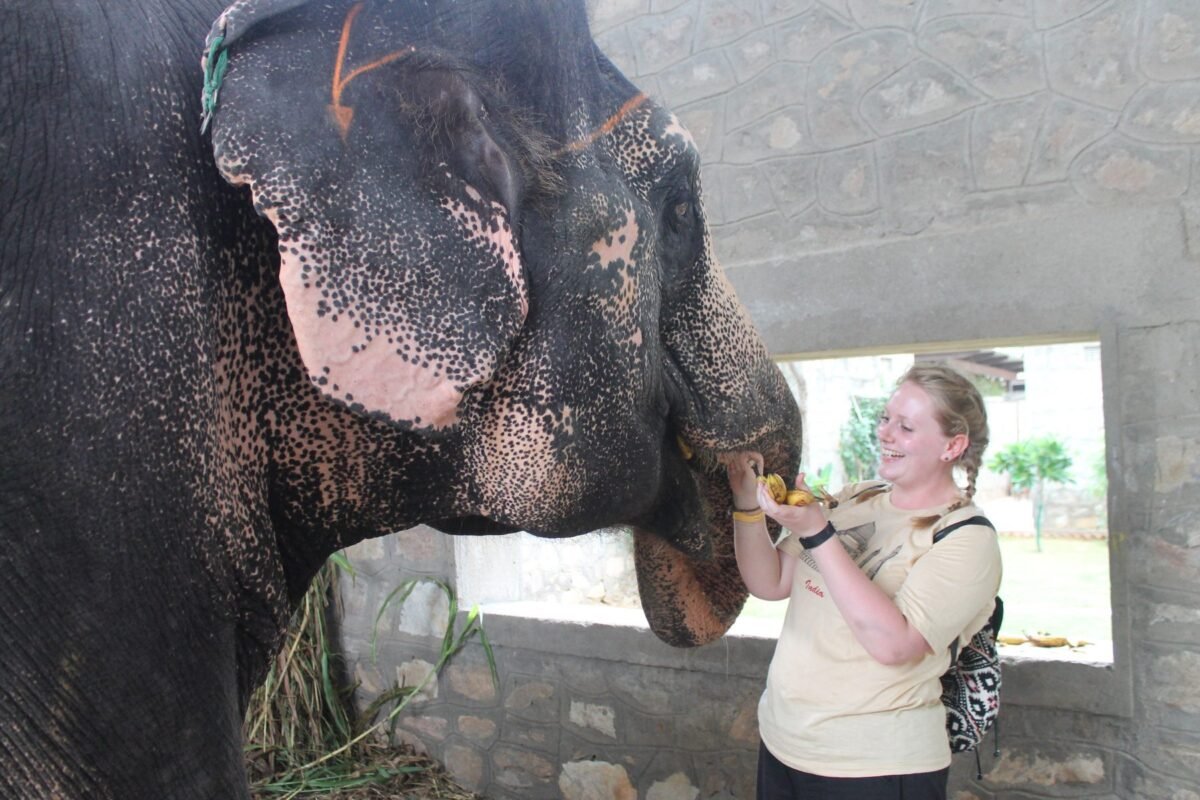
Would you like to help India’s wildlife as well as watch it? Our childcare and elephant program includes three days at a rescue center for elephants near Agra, where you prepare food, build enrichment and walk alongside the elephants with their keepers. There is no riding, bathing or performing.
For more ideas for your free time, see our list of adventure activities in India. To plan a wildlife trip around your placement, email info@volunteeringindia.com or browse our programs in Delhi and Jaipur.