
India’s forts tell its history in stone: Mughal emperors and Rajput kings, sieges and surrenders, mirrored palaces built inside walls made for war. Rajasthan alone has dozens, and six of its hill forts together form a UNESCO World Heritage Site. Many of the finest are within a few hours of Delhi and Jaipur, and some are right on your doorstep.
Here are seven to add to your list, plus a few more for longer trips.
1. Red Fort, Delhi
The Mughal emperor Shah Jahan built the Red Fort as the palace of his new capital, Shahjahanabad, and it was completed in 1648. Its red sandstone walls run for more than two kilometers around marble pavilions, gardens and the halls where emperors once received their court. You enter through the Lahori Gate and the Chhatta Chowk, a covered bazaar that still sells souvenirs.
The Red Fort is a UNESCO World Heritage Site and a national symbol: every year on Independence Day, 15 August, the Prime Minister raises the flag and speaks from its ramparts. It’s a short walk from Chandni Chowk, so combine the two on a weekend in Old Delhi.
2. Agra Fort
Most visitors to the Taj Mahal see Agra Fort too, and it deserves the time. Emperor Akbar rebuilt it in red sandstone from the 1560s, and his grandson Shah Jahan added white marble palaces inside. Shah Jahan spent his last years confined here by his son Aurangzeb, and tradition says he passed his days gazing down the river at the Taj Mahal, the tomb he built for his wife.
Agra Fort is a UNESCO World Heritage Site in its own right, and an optional stop on our Taj Mahal day trip and Golden Triangle tour.
3. Amber Fort and Jaigarh, Jaipur
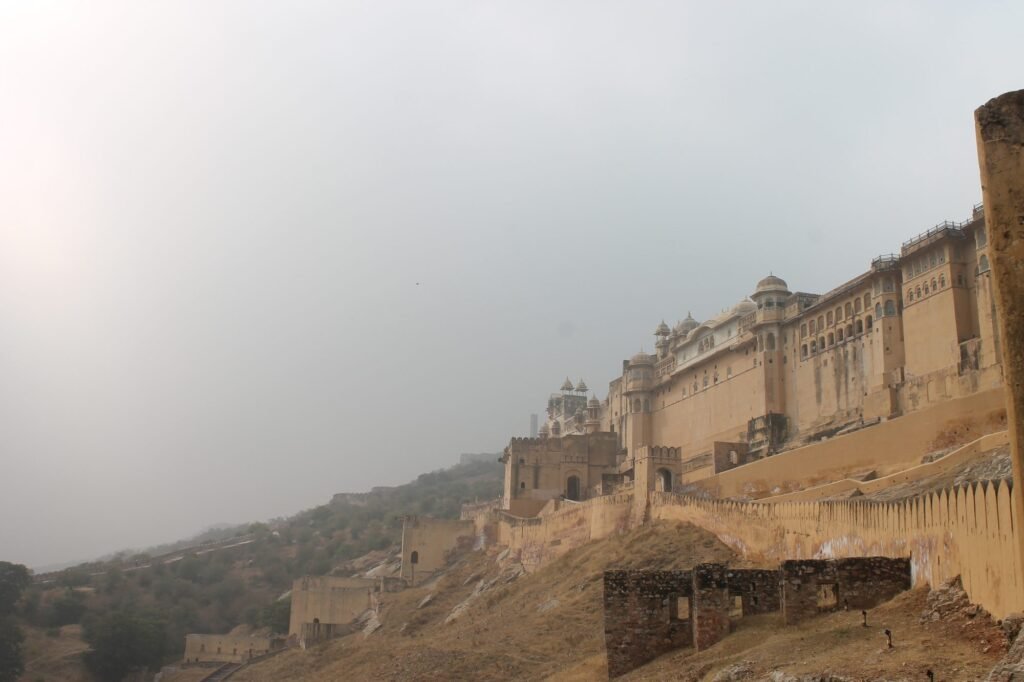
Amber (or Amer) Fort rises above Maota Lake about 11 kilometers from Jaipur, its walls snaking along the surrounding hills. Raja Man Singh began it in the late 16th century, and it blends Rajput and Mughal styles: grand gateways, courtyards, audience halls and the Sheesh Mahal, whose walls and ceilings are set with thousands of tiny mirrors.
Above it, linked by long defensive walls, Jaigarh Fort guards the ridge and keeps the Jaivana, a giant 18th-century cannon on wheels. Walk up the ramp to Amber or take a jeep; we’d skip the elephant rides offered at the bottom. Amber Fort is part of our Jaipur weekend and the Golden Triangle, and if you volunteer in Jaipur, it’s an easy outing on a free afternoon or weekend.
4. Nahargarh Fort, Jaipur
Nahargarh stands on the edge of the hills directly above Jaipur, built in the 18th century as part of the city’s defenses. Inside, the Madhavendra Bhawan holds a set of matching apartments built for a maharaja’s queens, linked by corridors. Most people come for the view: at sunset the whole Pink City spreads out below and the lights come on one by one. Go by road, or walk up the old path from the city with friends in the cool of the morning.
5. Mehrangarh Fort, Jodhpur
Few forts look as formidable as Mehrangarh, which rises straight out of a rocky hill above the blue houses of Jodhpur. Rao Jodha founded it in 1459, and inside its massive walls are carved sandstone palaces and one of the best museums in Rajasthan, full of royal palanquins, paintings, textiles and arms. The fort is still run by a trust set up by Jodhpur’s royal family.
Afterwards, wander down through the blue lanes of the old city. Jodhpur is about five hours from Jaipur by train, and film fans may recognize the fort from The Dark Knight Rises.
6. Chittorgarh Fort
Spread across a long plateau above the plains of southern Rajasthan, Chittorgarh is one of the largest forts in India, with palaces, temples, reservoirs and two carved stone towers inside its walls. It was the capital of Mewar for centuries and is remembered for three great sieges, and for the stories of Rani Padmini and of Meera Bai, the poet-saint.
Chittorgarh is part of the Hill Forts of Rajasthan World Heritage Site. It makes a good day trip from Udaipur, about two hours away, or a stop on the way there from Jaipur.
7. Jaisalmer Fort
Rising from a hill in the Thar Desert, Jaisalmer’s sandstone fort was founded in 1156 and is one of the few “living forts” left in the world: families still live inside, alongside temples, shops, cafés and guesthouses in the narrow lanes. At sunset the walls turn a deep gold, which is why it’s often called the Golden Fort.
Jaisalmer Fort is another of the UNESCO hill forts. Its old drains struggle with the water used by the hotels inside, so conservationists suggest staying outside the walls. Combine it with a night in the desert dunes; overnight trains run from Delhi and Jaipur.
More forts for longer trips
- Kumbhalgarh, two hours from Udaipur, hides behind a wall that runs for more than 30 kilometers across the Aravalli hills.
- Gwalior Fort, about three hours from Delhi by fast train, crowns a sandstone plateau with blue-tiled palaces, ancient temples and giant rock-cut Jain statues.
- Kangra Fort, near Dharamshala in Himachal Pradesh, is said to be one of the oldest forts in India and an easy detour on an independent trip to McLeod Ganj.
Tips for visiting forts
- Go early in the day, especially in summer: forts mean a lot of walking and climbing, often in full sun.
- Wear comfortable shoes and carry water.
- Hire a licensed guide at the entrance, or use an audio guide where one is offered. The stories are half the fun.
- Bring your student card if you have one, since some monuments give student discounts.
Want to see Rajasthan’s forts while you volunteer? Our Jaipur programs put you in the middle of them, and our weekend trips take volunteers in Delhi to Amber and Agra. For help planning, email info@volunteeringindia.com.